Wednesday, 17 April 2019

Labours of Love


Irene's Ghost
Documentary film-makers have always been well represented at Borderlines and 2019 was no exception. Irene's Ghost (2018), directed by Iain Cunningham, was a quest to resurrect the memory of his mother who died when he was just three years old. Watching it was a deeply immersive and highly emotional experience. In the Q&A afterwards, Cunningham revealed that he had worked on the film for five years. This got us thinking and talking about other great documentaries where the film-makers had been willing or driven to put in the time: Hoop Dreams (Steve James, 1995) followed the hopes and aspirations of two young basketball protegees over the course of four years, for example. Marcel Ophuls worked for decades on Hotel Terminus (1988). This was the documentary maker on an heroic quest, to track down and expose the war criminal, Klaus Barbie, the infamous 'Butcher of Lyon' and in which he succeeded and procured justice in the name of all who suffered and died because of this man.

Of Love and Law
Of Love and Law (Hikaru Toda, 2017) follows two young lawyers, who live and work in Osaka, over the course of a year. Openly gay in a still deeply patriarchal and closeted society, they specialise in minority cases. The camera throughout is effortlessly unobtrusive and it is a little startling when, whilst bickering across the breakfast table, one of the lawyers turns directly toward the camera and talks to the film-maker and of course, by extension, to we the audience. 'Are you happy' he chortles, 'to have caught us arguing?' When the film ends we feel as if we are deserting the lawyers mid-stride, as they continue to strive for change and equality one small step at a time.

The Raft
The Raft (Marcus Lindeen, 2018) documents a flawed social experiment from the 1970s where anthropologist Santiago Genoves wished to explore human behaviour in a confined setting without access to the outside world. He, together with six women and four other men, set sail on a specially commissioned raft to cross the Atlantic. Genoves had very set ideas about what would probably happen but when the sex and violence failed to materialise as he had envisaged he became somewhat disengaged and acted in the very way he had expected of his 'specimens'. Fe and Maria, the raft's captain, clearly recognised Genovese's deep rooted sexism and prejudices and these two came across as the ones who most challenged and angered him. It was interesting that the other women interviewed for this compelling and revealing documentary seemed accepting of his behaviour even when he placed their lives in danger having mutinied and taken over as ship's captain during a life threatening hurricane and then had to relinquish this role back to Maria. The ending, which records his not particularly convincing apology, also shows him turning it all to his own advantage when he later published a book about the experiment. Thankfully, this documentary has helped to set part of this record straight.
Rosa Luxemburg
Rosa Luxemburg (Margarethe von Trotta, 1986), was introduced by Selina Robertson, Film Programmer at Club de Femmes and ICO, who explained that von Trotta had inherited the project from Fassbinder following his death. Von Trotta spent some two years researching her subject and was given access to 2,500 of Luxemburg's letters to study. This level of dedication and commitment is up there on the screen and this is a richly detailed and masterful biopic because of that research. Along with actress, Barbara Sukowa, von Trotta brings Luxemburg vividly to life.

Performance
Performance (Donald Cammell & Nicolas Roeg, 1970) was written by Donal Cammell, his Ortonesque gangsters a gallery of camp grotesques, their banter shocking and absurd. Cammell co-directed the film with Roeg, who of course went on to have a distinguished career. Not so Cammell who faded into obscurity and who committed suicide in 1996, aged 62. It is difficult not to draw comparisons with Jagger's reclusive musician Turner. 'He's stuck', Anita Pallenberg's Pherber tells James Fox's Chas. Cammell's script is wonderful, witty and subversive and quite literally one of a kind.

Christine and Mark Renney ©Matthew Evans
Christine and Mark Renney
From Dull and Flat Bedfordshire

Sunday, 24 February 2019

Watching films online


The Wife

Borderlines Film Festival 2019 will screen 10 films featured among this year’s Academy Awards nominees. But you can see every single nominee pirated online. You have nothing to lose but your identity. It’s a small risk.

I missed Bad Times at the El Royale, the potential word of mouth sleeper hit that disappeared from cinemas after a week. The DVD is a tenner from Sainsbury’s. A 23 year old friend pointed out the many ways I could watch it online, none of which contribute towards the production’s balance sheet. He imagined that they received some money from the ads.

I don’t care that, apparently, watching an uploaded DVD is not illegal. It’s not illegal because the legislative process is outrun. It is, however, wrong and a lot less fun than doing the square thing.

Do you remember when films weren’t ubiquitous? You can buy them for pennies, there are dozens broadcast on Freeview every day and thousands are streamed online complete with their creators’ permission. “Ah,” I hear you say, “You miserable hypocrite. What about those ‘otherwise unavailable’ examples of ‘cult’ British cinema you ‘discovered’ on YouTube the day you got broadband?” Yeah, well, that crime was its own punishment. To quote Marx, “Those are my principles and if you don't like them... well, I have others.”
Green Book
Borderlines Film Festival 2019 will screen 10 films featured among this year’s Academy Awards nominees. The winners will be announced over two days at the end of February. The Borderlines picks are: A Star Is Born (8 nominations), Vice (8 nominations), Green Book (5 nominations), Cold War (3 nominations), If Beale Street Could Talk (3 nominations), The Wife (Best Actress), Free Solo (Best Documentary) and Border (Best Makeup and Hairstyling). There are three nominees from the Best Foreign Language Film category: Cold War, Capernaum and Shoplifters.

Free Solo
Faces Places (Dir. Agnès Varda, 2017) was nominated for Best Documentary Feature last year. It is, I believe, the first film to be screened at the Borderlines Film Festival two years running.

Faces Places
However, there are three nominees that are only available to Netflix subscribers: Roma (10 nominations), End Game (Best Documentary Short) and the Joel and Ethan Coen “anthology film” The Ballad of Buster Scruggs (3 nominations).

This is problematic. (Particularly in a blog encouraging you to go to Borderlines). Steven Spielberg, in an interview with ITV News in March 2018, spelled out the issue: “Once you commit to a television format, you’re a TV movie. You certainly, if it’s a good show, deserve an Emmy, but not an Oscar. I don’t believe films that are just given token qualifications in a couple of theaters for less than a week should qualify for the Academy Award nomination.”(Source)

Last week J. Timothy Richards, the founder and CEO of U.K. exhibitor VUE, the largest exhibitor outside the U.S., wrote an open letter to BAFTA about these concerns. He stated, “It is clear that Netflix made at best a token effort to screen Roma, screening it to less than 1% of the U.K. market solely because it wanted an award.” (Source)

I spoke to a manager of a local independent cinema. Their customers are asking to see Roma. The cinemas want to screen Roma but the studio that made it, Netflix, wants film-lovers to stream it from their website. This is a new development: film-makers used to support cinemas.

There was a similar situation last October. Peter Jackson’s They Will Not Grow Old was premiered at the London Film Festival, received a lot of media attention and cinema-goers wished to see it. It was broadcast on BBC2 the following month and no more was said. The BBC helped to make it and I doubt they’d object to cinemas showing it next Armistice Day. (Source)

The issue isn’t exclusivity. A month’s subscription to most streaming services costs less than the average price of a cinema ticket. I’m reminded of 1980s drugs awareness campaigns: “I thought I could handle it. The dealer started me on the best stuff but I began binge-watching third-rate American shows within days.”

Other pushers are available. Wired magazine listed 16 mainstream Oscar-nominated movies available via iTunes, Amazon Prime Video or YouTube. HBO Go has a deal with Isle of Dogs and Hulu stocks Minding the Gap and RBG. Other territories have their own services and the web is world wide. (Source)

Awards season is vital to cinema and cinemas. The previous Yorgos Lanthimos flick, The Killing of the Sacred Deer, was picked up by one venue in the entire south-west quadrant of England. It starred Nicole Kidman and Colin Farrell. Many people liked The Lobster but not many people went to see it. I suspect that cinemas lost money. Four years on The Favourite is playing to full houses. Some of the audience want to see what’s getting all this attention. Most are there because Olivia Colman is in it.

As Sacha Baron Cohen pointed out Hollywood wouldn’t bother with certain genres if it wasn’t for the awards season. These films need the chance of an awards buzz to have a chance of making money. Thus awards promote the more ‘demanding’ films and art houses show them. This is very old news.

Basically the movie industry is a whale decomposing on the ocean bed. Cinematic masterpieces are the miniscule flecks of protein flaking off it. One-screen cinemas are the tiny crustaceans which survive on these scraps. Independent cinema managers sense that an Academy Award for Roma is good for Netflix but cuts them out.

The moving picture industry has been facing up to crises since the first gas-powered Magic Lantern exploded. What will independent cinemas do if they cannot screen the award-winners?

Still, they won’t be the only business plans thrown against the wall this year.

Robin Clarke

22/02/2019

Friday, 6 April 2018

Borderlines and the Snow Show

After all the grumbling about the snow and the films we missed, we thought it would be good to say something about some of those we did manage to see and so here goes:

Custody
Custody by Xavier Legrande was as unsettling as it was compelling. Comparisons to the Dardenne Brothers are certainly apt, especially their earlier works such as The Child. We agree with the review in Little White Lies that it is a film of two halves and the second half built to a fraught and nail-biting conclusion with the precision of the most effective of thrillers but not at the expense of its social commentary.
Zama
Lucrecia Martel's existentialist tale of colonial displacement, Zama, was beautifully framed. It made us think of Werner Herzog, especially Aguirre, The Wrath of God (definitely a good thing) but unlike Klaus Kinski's Conquistador, the central character sits as a relatively rational being which contrasts with the levels of crazy going on around him. A flawed character, yes, but Zama just wanted to return home to his wife and family but could not grasp how to be or what to do to achieve this whilst others, apparently being punished, seem to reap the rewards Zama seeks for himself.

The Shape of Water
The Shape of Water is not so much a remake of Jack Arnold's Creature From The Black Lagoon but more a second attempt at a sequel after Arnold's own Revenge of The Creature but it also so much more than that. A magical love story, set in the immediate post-Joe McCarthy era during which Hollywood produced many great films, Westerns, Melodramas and of course Film Noir with the screenwriters and directors un-credited and the anti-McCarthyite message cleverly cloaked. Conversely in The Shape of Water, nothing is hidden, and shows everything Guillermo del Toro and his team intended. It is a fable, a fairy tale about the beauty of otherness and as such reminds us of Cocteau's Beauty and The Beast, a mythic and stunning creation to which we would compare The Shape of Water. Guillermo del Toro, recently interviewed on Radio 4's Film Programme with Francine Stock, explained how he showed Sally Hawkins many silent films to study the use of expression in place of the spoken word, which she did brilliantly, and let us not forget that this is the woman who couldn't stop talking in Mike Leigh's Happy Go Lucky.

And thank you for showing Behind The Door - it was so worth seeing.

We came to The Wound, directed by John Trengrove, without any preconceptions but quickly found ourselves immersed in its questioning of what is manhood and why does it need to be publicly proven to other men via the traditional rites of circumcision? The principal character is gay and, if it were known, would not be treated as a man within the society he inhabits, and yet he submitted to the tradition in which he now oversees teenagers as they go through the same ritual. His treatment by his 'annual' lover, whom he has known and cared about for many years, is difficult to watch as we see the price paid by gays within deeply entrenched traditional communities. Some critics have questioned the ending and whether it was a mis-step but we felt his final action was still to protect the man he loves from being 'outed' rather than for his own safety. We found it both absorbing, educational and upsetting.

Lean on Pete, based on the book by Willy Vlautin, a great American storyteller in the vein of Raymond Carver and Denis Johnson, and a musician par excellence, was beautifully realised and so well researched as were the perfectly drawn performances from Steve Buscemi and Chloe Sevigny, who last appeared together, as Robin has pointed out, in Buscemi's directorial debut Trees Lounge from 1996 which we know he is not fond of but what can we say, we kinda love it.

Loveless
Is Loveless a film where the message is also cloaked? It is certainly an important work from Andrey Zvyagintsev, a powerful and searing indictment of Russia under Putin where no lessons are learned as we watch the two main protaganists recycle their bitter and unhappy experiences together with new partners. The missing child, an innocent, is not even worthy of investment of time by the Police and it is left to volunteers to try and trace him. There are no questions about why he would go missing and this is in a country which is happy to erase people from its history in one way or another with no conscience on show.

And has the mobile phone ever been as prevalent as it is in Loveless? The lead female character is certainly obsessed with hers, constantly taking selfies and gazing longingly down into its screen. It is reflected in the windows of their apartment and in the windshield of the car. It is often the only source of light when it is dark but none of this is about communication which all fail to do face to face. It is the era of having many contacts and few friends.

We will see you next year.

Christine and Mark Renney from dull and flat Bedfordshire.

Sunday, 4 March 2018

Hail to thee Borderline spirits

Sweet Country
We browsed the brochure, we picked and booked our films, we booked b&b and self-catering accommodation out in 'the sticks' and we were all set to arrive in Hereford on 1 March. Only we didn't because of, yes, the snow.

Our first film was to be Sweet Country the second fictional work by director Warwick Thornton since his debut Samson and Delilah in 2009, followed by Loveless by Andrey Zvyagintsev, both directors whose work deserves to be seen on the big screen. Our first film now will be Custody directed by Xavier Legrand, the winner of the Silver Lion at the Venice International Film Festival. Our second film to view will be Zama directed by Lucrecia Martel whose work The Headless Woman, which was screened at Borderlines in 2017 is one of our favourites of the last decade and which speaks of lies and the power to avoid punishment endemic in the wealthy classes.
Zama
However, we managed to get into Cambridge today to see Greta Gerwig's film Lady Bird which is funny and touching and was one on our list of bookings. We now hope to see Free and Easy by Geng Jun as we are intrigued by the comparisons to Keaton, Beckett and Kaurismaki - we are big fans of all three.
Free and Easy
In our local supermarket on Thursday we were able to pick up copies of The Party and The Death of Stalin - we watched and enjoyed both but were unable to recreate the Borderlines experience of a convivial viewing alongside other film enthusiasts in a drafty village hall with, possibly, a tea and biscuits pause half way through. But at least we were warm, watching films and safe.

We must thank the Borderlines Team, particularly Naomi, as it was agreed that we could either find other films to see using the tickets we could not take up or hold them over until next year. It is this love of film and appreciation of its audience that makes Borderlines an incredibly friendly experience and we appreciate the gesture very much.

We remain loyal supporters of the event and will see you tomorrow.

Christine and Mark Renney
from flat and dull Bedfordshire

Saturday, 3 March 2018

A Distorting Lens of Directors


You Were Never Really Here
In one piece in Confessions of a Cineplex Heckler: Celluloid Tirades and Escapades (2000), Joe Queenan waits in the lobby of a multiplex, fully prepared to hand actual money to any member of the public who can name the director of the movie they have just watched. It did not cost him much. Even the ‘name’ directors didn’t register. I suspect that most other people recall their visits to the cinema in order of preference.

One pleasure of a new Borderlines programme is looking for work by directors who have delivered the goods in the past. They all have of course or they wouldn’t be in the schedule. When a former Borderlines selection is screened on Film4 I know it’s going to be worth catching. If someone made a Super Size Me for watching every new release, six hundred in the UK alone last year, I wonder which part of mind & body would fold first? There are many directors whose body of work I don’t know – but I do know that online reviewers rave about every single one. Here are my ravings.
Jeune Femme
There was some excitement among film society types in 1999 when Lynne Ramsay’s first feature Ratcatcher was released. Here was a new, young, female Scottish director who could really put a film together. In 2002 this excitement spread to the review sections of selected broadsheets when she followed it with Morvern Callar: Samantha Morton’s portrait of a modern woman sans archetype to a 'hold the zeitgeist' soundtrack. It was Generation X’s Lady Bird (2017) sans box office, leur Jeune Femme (2017) de l'époque. Since then Ramsey’s rate of output makes Stanley Kubrick look like Takashi Miike. To give you some idea of how long it’s been, Morton’s characters are still low-waged but they’ve moved beyond casual sex in the Costa del Sol. She played the cook in August Strindberg’s Miss Julie (2014). After Morvern Callar Ramsey spent two years adapting an early draft of The Lovely Bones – and then Alice Sebold’s novel was completed, published and became a best-seller. Peter Jackson directed the movie version in 2009; it stars a 14-year old Saoirse Ronan. Source: The Guardian 

It was another 9 years until Ramsay’s third feature, another adaption of a novel, the uncompromising We Need to Talk about Kevin (2011). The next person to describe Lynne Ramsay’s work as “uncompromising” or "long-awaited" could have clichés in their copy. By way of comparison, Michael Winterbottom directed 13 features between 2002 and 2011. Since 2011 Ben Wheatley has directed 5 films without surpassing his work on BBC3 Johnny Vegas sit-com Ideal. The long-awaited You Were Never Really Here (2017) is Lynne Ramsay’s fourth picture.
The Third Murder
You may have seen Nobody Knows (2004) by Hirokazu Kore-eda at Borderlines 2014. You may still be recovering. In modern day Tokyo four abandoned siblings are left to look after themselves. Kore-eda played me like an accordion for 141 minutes. His latest is at Borderlines 2018: The Third Murder.
Loveless
During Borderlines I seek out depressing Eastern European movies that my local picture palaces would never dream of screening. So I’m always in the market for the latest by Andrey Zvyagintsev. His Elena (2011) was particularly bleak; I want to see how Loveless (2017) portrays today’s Russia. The plot also sounds a bit close to a notorious Christopher Morris sketch, Unflustered Parents, from his BBC Radio 1 show Blue Jam (1997 to 1999).
A Fantastic Woman
Billy Wilder watched Brief Encounter (1945) and wondered about the unseen character who lends Dr. Alec Harvey (Trevor Howard) his flat. What was his story? Then he made The Apartment (1960). Sebastián Lelio’s Gloria (2013) was inspired by Laura Branigan’s disco classic of the same name (1982). All together: “Will you marry for the money? Take a lover in the afternoon? Feel your innocence slipping away; don’t believe it’s coming back soon. And you really don’t remember? Oh, was it something that he said? Are the voices in your head calling, ‘Gloria?’ Gloria, don’t you think you’re falling? If everybody wants you, why isn’t anybody calllllling?” Now that’s a character description. It’s a Film4 regular. Lelio returns with A Fantastic Woman (2017), a big winner at the Berlin Film Festival. There have been many, many movies about gender identity. There are the ones you’ve heard of and the rest are plotted against deranged and exploitative, scattered beyond the Psycho (1960) to Dressed to Kill (1980) trend-line.
Lean on Pete
Andrew Haigh directed 45 Years (2015) – in my opinion the smartest British movie this century – so I am looking forward, quietly, to Lean on Pete (2017). I notice that it stars Steve Buscemi and Chloë Sevigny. Before her name grew an umlaut Chloe Sevigny’s second movie, Trees Lounge (1996), was Steve Buscemi’s first movie as director. He was an alcoholic who worked an ice cream van; she wore leggings and hung out. In 1994 Jay McInerney took seven pages in The New Yorker to call Sevigny “the coolest girl in the world”. Buscemi was still a bit cool because he’d played Mr. Pink in Reservoir Dogs (1992). Trees Lounge wasn’t that great – it took me two goes to realise I’d already seen it – but it was the mid-1990s, the internet was coming closer and the World was getting ready to party like it was 1999. Lean on Pete will be their second movie together.

Talking of the 1990s, spotting Claire Denis in the Borderlines 2018 brochure made me smile. I am very fond of the Nenette et Boni (1996) OST by Tindersticks, a Nottingham band who contributed to or composed six of her soundtracks. Nine of these numbers were compiled on a cover-mount CD free with the May 2011 issue of Sight & Sound (Volume 21 Issue 5). I was also reminded of screening the superb Beau Travail (1999) at Worcester Film Society, a few years before art house film societies were scuppered by, erm, Film4, the internet and a flood of cover-mount DVDs.
Let the Sunshine In
Seeing Juliette Binoche and Gérard Depardieu cast together gave me the giggles. Let the Sunshine In (2017) will be the first film to star both but it will not be their first memorable co-production. An entertaining little tiff began when Depardieu opined (2010): “Please can you explain to me what the secret of this actress is meant to be? I would really like to know why she has been so esteemed for so many years. She has nothing. Absolutely nothing! She is nothing. Compared with her, Isabelle Adjani is great even if she's totally nuts. Or Fanny Ardant - she is magnificent, extremely impressive. But Binoche? What has she ever had going for her?”

La Binoche responded in a dignified fashion: which is to say she landed a few digs whilst responding in a dignified fashion. They put on a great show. Recently, Depardieu starred in Marseille (2016), a Netflix series that garnered frenzied reviews in France. The rest of the World quite liked it however and he’s making a second series. He was also in Valley of Love (2016) with Isabelle Huppert. His gut dwarfed Death Valley. Binoche’s previous Borderlines appearance was last year’s surreal comedy Slack Bay (2016). Opinion was divided: I enjoyed it. The local linguists were in hysterics every time Inspector Malfoy spoke. And one-eighth of the audience left long before the end.

Sight and Sound (December 2017) observed that Happy End (2017), “Michael Haneke’s most interesting film since Hidden (2005), and also superior to his back-to-back Palme d’Or winners The White Ribbon (2009) and Amour (2012)” was his first feature since 2003 not to win a prize at the Cannes Film Festival. To the magazine’s own surprise it did not feature in their ‘Best Films of 2017’ poll. The Borderlines 2018 selections Zama, Western, Faces Places, Loveless, 120 BPM, You Were Never Really Here, God’s Own Country, The Shape of Water, Lady Bird and Let the Sunshine In all made the Sight and Sound Top Twenty. Such slips are relative. I really enjoyed The Lobster (2015) and so did many others. I could not find a cinema screening Yorgos Lanthimos’ follow-up, The Killing of the Sacred Deer (2017), nearer than Bristol. Nicole Kidman and Colin Farrell are in it! Some movies just disappear.
Journey's End

Finally, Journey’s End (2017) adapts R. C. Sheriff’s 1928 play of the same name. It was first filmed in 1930 and has been made for television at least five times since then. The BBC’s 1954 version, probably live to air, starred Bryan Forbes, whose The L-Shaped Room (1962) is part of this year’s Borderlines programme. The book Hollywood’s World War I Motion Picture Images (Bowling Green State University, 1997) notes that the public appetite for war films waned after World War I – until The Big Parade (1925), a $10 million making hit for MGM, found “a kind of perfect neutrality between embarrassing flag-waving and noxious despair”.

It was followed by What Price Glory? (1926), based on a long-running Broadway play, All Quiet on the Western Front (1930), Journey’s End (1930), The Road to Glory (1936), The Road Back (1937), Three Comrades (1938) and many more depictions of life and death in the trenches. As many movies again were set among ‘the young Knights of the air’. In 1929, one of these, Wings (1927) was the first winner of the Academy Award for Best Picture. It might be worth watching a few of these for context then revisiting The Marx Brothers’ war movie Duck Soup (1933): “You're a brave man. Go and break through the lines. And remember, while you're out there risking your life and limb through shot and shell, we'll be in here thinking what a sucker you are.” This was before The Great War was re-made with a more convincing bad guy.

Journey’s End (1930) is of particular interest because it was directed by James Whale. Whale was born in Dudley, Worcestershire in 1889, the sixth son of a blast furnace man and a nurse. During World War I he served as a second lieutenant in the Worcestershire Regiment. He spent the final year of the conflict as a Prisoner of War. It was at the Holzminden POW camp that he first became involved in theatre. Ten years on he directed the premiere of Journey’s End, casting the little known Laurence Olivier in the lead role. Journey’s End soon transferred to the Prince of Wales Theatre where it ran for two years. In 1929 Whale was called to Broadway to direct Journey’s End there. It ran for a year. In 1930 he directed the movie version. In 1931 he directed the definitive Frankenstein. Well, how do you picture the monster?

Robin Clarke

Thursday, 1 March 2018

Human Flow

Tuesday’s 1.30 screening of Human Flow at The Courtyard, alas the last of three, was all but sold out. Remarkable, for a 2hr 20 min doc that can at times feel unrelenting. But entirely appropriate. We all know, or think we know, the story - but the scale of it - 65 million displaced people across the globe - alone justifies the length of the movie. Ai Wei Wei’s documentary, however, is far more than an exhausting catalogue of suffering. Duncan Wardlaw’s BFF notes and multiple laudatory reviews make that very clear. But what’s less noticed is the scale of the effort that both Ai Wei Wei and his crew - over 200 people worldwide, a dozen of them, including Ai himself, cinematographers, sixteen additional cinematographers, thirteen drones and one steadicam operator. An extraordinary but wholly justified camera department that produced some stunning results - including two aerial shots that alone are worth the price of admission.

Ai Wei Wei’s mobile phone footage features throughout, as does Ai Wei Wei, cutting hair, swapping passports, respecting, investigating, collaborating, witnessing. The editing of 1,000 hours of footage had at its helm Niels Pagh Andersen, best known for Joshua Oppenheimer’s Academy Award nominated documentaries about Indonesia, The Act of Killing and The Look Of Silence. Anyone who wants more should go to the comprehensive press kit.
The Courtyard projection team at work

Even if you stuck around for the credits, there’s plenty more there, but what it won’t have is a big shout out to Simon Nicholls and the projection crew at The Courtyard. Pin sharp pix, beautiful sound - they produce excellent results day in, day out. Not easy. Anyone spurred to action by Human Flow found People In Motion at the door with flyers about their work with refugees. In a country whose proud record includes the Kindertransport, they, and Ai Wei Wei’s film, are more than deserving of our support.

Stephen Hopkins

Tuesday, 27 February 2018

Shorts Selection

Journey’s End (2017), as I’ve mentioned in another blog, first opened as a play in 1928. It was directed in the theatre by James Whale. It ran for two years in London and, concurrently, one year on Broadway. Whale continued to direct Journey’s End in New York and, subsequently, directed the movie version in 1930. The following year he gave Frankenstein (1931) to posterity. James Whale was a gay man from Dudley.

Whale’s final days were fictionalised in the bio-pic Gods and Monsters (1998) starring Ian McKellen, Brendan Fraser and Lynn Redgrave. Lynn Redgrave died of breast cancer, aged 67, in 2010. This month Brendan Fraser gave the most revealing celebrity interview by any movie star for many years. The toll that his acting roles have taken on his health is interesting enough. Then he explains how #metoo includes men too. Please check out Zach Baron’s interview with Brendan Fraser in GQ magazine.

Ian McKellen is in one of the shorts being shown – free of charge, gratis and for nothing - by Borderlines 2018 tomorrow at 2.30pm, Wednesday 28 February.

He is the narrator of Edmund the Magnificent (2017, 14 minutes) which stars David Bradley, Rebecca Front and Mark Bonnar. It was written and directed by Ben Ockrent. The comedy, set in a picture-book version of the countryside, concerns a country show, a farmer and his pig. The pig is having problems in the bedroom. Here’s the trailer:
Edmund The Magnificent - Trailer from HAUS Pictures on Vimeo.

The Full Story (2017, 8 minutes) was written by Daisy Jacobs and directed by Daisy Jacobs and Christopher Wilder. Her previous animation, and her graduation film, The Bigger Picture (2015), won a BAFTA and was nominated for an Academy Award in the category of Best Animated Short Film. In The Full Story (not a title made for search engines) a man, selling his childhood home, recalls its tense history. It is animated using various techniques. The film is in English but it was made in France, a major centre in animation. Here’s the trailer:

Submissions ÉCU 2015 - The Bigger Picture TRAILER from ecufilmfestival on Vimeo.

Remora (2016, 19 minutes) was written and directed by David Schofield. Filmed in Rhyl and Towyn on the North Wales coast, in November 2015, the story begins with a loan shark, his debt collectors and those vulnerable people, addicts and the mentally ill, who provide their bread and butter. Events happen. Here’s the trailer:

Remora Trailer from David Schofield on Vimeo.

And here’s the soundtrack, written by William Morris and performed by William Morris and The Didsbury String Quartet:
This is the film’s own website.

Ramona and The Chair (2016, 12 minutes) was written and directed by Dominique Lecchi. Ramona talks to her therapist but – don’t ask me how because I haven’t seen any of these – an empty chair in the room gets involved. You may recognise the empty chair from its work alongside Clint Eastwood.

I could not find a clip. The director discusses her film here:
The short has its own website.

Lecchi’s previous, and debut, short Balsa Wood (2014, 10 minutes) in its entirety:

Balsa Wood from Dominique Lecchi on Vimeo.

Fifth and finally, the comedy Some Sweet Oblivious Antidote (2017, 15 minutes). The title comes from ‘the Scottish play’, Act 5 Scene 3:

Cure her of that.

Canst thou not minister to a mind diseased,

Pluck from the memory a rooted sorrow,

Raze out the written troubles of the brain

And with some sweet oblivious antidote

Cleanse the stuffed bosom of that perilous stuff

Which weighs upon the heart?

“Official synopsis: Exasperated by her daughter Ivie’s refusal to converse in anything other than Shakespearean verse, Esosa resorts to psychoanalysis for a cure. The psychiatrist and her therapist struggle for a solution until a full-on Shakespearean quote-off on a theatre stage uncovers the reason for Ivie’s affliction.” Source.

Another article.

It was written by Moya O’Shea, directed by Christiana Ebohon, has “a largely female crew” and a mostly British/Nigerian cast. Wunmi Mosaku is Esosa, Fatima Koroma is Ivie and Sir Lenworth George Henry, CBE plays the therapist.

Hence, three of these five shorts get a F-Rating and two of them are triple F-rated.

Ebohon has directed 96 (ninety-six) episodes of the beloved BBC1 dinner-time serial Doctors and a couple of the international smash-hit Father Brown as well as instalments of Emmerdale, Eastenders and Hollyoaks. Mark Williams, who plays the title role of Father Brown, was born in Bromsgrove.

I used to plough through scores of short films 15 years ago and, a few stand-outs aside, the quality of film-making and standard of story is far higher these days. Believe me.
Thirsting for more? Go mad.

Lenny “Lenny Lenny Len, Lenny Lenny Len, Lenny Henry Show” Henry is a Shakespearean actor from Dudley. As Stan Laurel didn’t say: All roads lead to Dudley but a pencil must be led. And we’re done. Enjoy the flicks.

Robin Clarke

Sunday, 25 February 2018

I Still Hide To Smoke

I’d be surprised if this Borderlines came up with a film as relevant, shocking, courageous and timely as the one I saw last night at The Courtyard in Hereford. I’m sure I won’t see one for which, in its first incarnation as a play, the director was doused with petrol and had a lit cigarette flicked at her in a mercifully failed attempt to burn her to death. Rayhana Obermeyer’s I Still Hide To Smoke, set in a hammam in Algeria, is more than a revelation - it’s an urgent and necessary film about women, freedom, religion, sexuality, men and liberty. It has the backing of Costa-Gavras, echoes of Nell Dunn’s ‘Steaming’, and the lineage of Aristophanes ‘Lysistrata’ - not inappropriate for a film, through force of circumstance, mainly shot in Greece. The strikingly passionate performance of Hiam Abbas, an Israeli Palestinian actress most recently seen in Blade Runner 2024, brings to mind Brecht’s Mother Courage, whilst the final images of the film - countless black headscarves floating away on the wind - are a more than timely prophecy of the hijab protest we are now seeing in Tehran. Alas, last night’s screening of I Still Hide To Smoke was the only BFF screening, and the official YouTube trailer -
 

- isn’t, in my view, all that good. Anne Cottringer’s excellent BFF programme notes are available online, but for anyone who’s interested - and that should mean everyone - the French distributors press kit is a very thorough and beautifully produced summary of the film and its principal players. You can find it here. I urge you to seek out this brave and important film.

Stephen Hopkins

Saturday, 24 February 2018

The Subliminal Strand


Phantom Thread

One delight of a new Borderlines programme is the search for strands the team may not have known they had. A 'Phantom Thread’ if you like. It is usually a good idea to set a story in a time and place. A background of civil unrest or civil war forces each character’s personal credo into sharp relief; a milieu between the war movies and tales of the defiant dispossessed. Unlike The Death of Stalin (2017) here’s a place where people can represent competing political ideologies with only the occasional threat of sudden violent death. There’s a 'There’s a Riot Going On' season: Milou en Mai (1990; France 1968), I Still Hide to Smoke (2016, Algeria 1995), The Nile Hilton Incident (2017, Egypt’s Arab Spring 2011).

Borderlines 2018 boasts a rich seam for art lovers. Ai Weiwei is best known to occasional browsers of Sunday supplements as the artist behind the 'Sunflower Seeds' sculpture at Tate Modern, London, in 2010: millions of individually hand-crafted, porcelain, sunflower seeds. Weiwei directed Human Flow (2017), a documentary about the 65 million refugees currently displaced around the World. I predict, like Steve McQueen or Anton Corbijn before him, that the framing is impeccable.
Loving Vincent

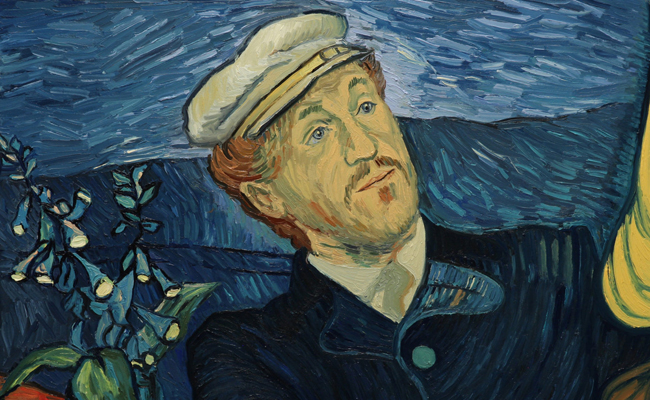
There are two bio-pics of artists: Loving Vincent (2017, Vincent Van Gogh) is animated in his Post-Impressionist style. His paintings are brought to life. Find out what 'Sorrowing Old Man (At Eternity's Gate)' was really like! Maudie (2016, Maud Lewis) is a big favourite of Toyah Willcox: “I love films! I have an expensive DVD library! One of the joys of where I live is that I'm 50 yards away from an arts centre that shows a film every Monday morning. I was blown away by Maudie with Sally Hawkins. It's about the naive artist Maud Lewis. Sally Hawkins’ performance in this is one of the best technical character journeys I have ever seen.” The Guardian
JR and Agnes Varda in Faces Places

Sally Hawkins’s last four movies are Paddington (2014), Maudie (2016), The Shape of Water (2017), Paddington 2 (2017). That is strong form. They all feature plenty of water. Agnès Varda’s latest documentary Faces Places (2017) was made with the artist JR. They are a good fit. He photographs the people they meet on their travels around France and turns these images into murals. His approach brings to mind Turner Prize winner Gillian Wearing’s 'Signs That Say What You Want Them to Say and Not Signs That Say What Someone Else Wants You to Say' (1993) on the scale of Turner Prize nominee Mark Titchner’s poster campaigns. Having found JR’s website –  – I’m reasonably wrong. His humour is much sillier. This is what JR displayed on a wall in Bethlehem.
The Nile Hilton Incident

Followers of Swedish cinema should note the five Ingmar Bergman films and three other Swedish directors. Look out for the acclaimed thriller The Nile Hilton Incident and the very enjoyable comedy A Man Called Ove (2017). Give the latter a go if you enjoy a swooping character arc but couldn’t stomach Three Billboards Outside Ebbing, Missouri (2017). Borderlines 2018 opens with Ruben Östlund’s Palme d’Or winning The Square (2017), a study of ‘the art game’. Östlund’s previous film - Force Majeure (2014), an account of a family holiday at a ski resort that reveals a stark home truth - looked good and was good. The design left no shadows for the disgraced father to hide in.
The Square

The Square
 is a big favourite of Laurie Anderson: “There are not enough comedies now, so I was relieved to see this. It’s hilarious. It skewers the art world, which is long overdue: that whole scene is pompous and ready for satire. The film looks at what happens when people step out of their social structures in Stockholm, and it makes you realise how isolated people are within their scenes. Elisabeth Moss is fantastic in it.” The Guardian

I only pay attention to the film recommendations of female solo artists who had big hit singles during 1981. It has never let me down.


Robin Clarke
Festival Volunteer

Friday, 24 November 2017

How did we get to this place?


120BPM
 People keep asking us how we choose the films for Borderlines.

Jan Doran, one of our regular volunteers and a trustee of Arts Alive/Flicks in the Sticks, attended the BFI London Film Festival and kindly gave us access to her report:
It takes days of eyeing up the festival programme before I can build up to tackling it and establishing a system that ensures I’m not endlessly re-reading blurb or doubling up on dates. Once I’ve cracked it I’m cramming as much as possible into my four-day extravaganza.  
Having recently been bowled over by Andrew Garfield’s fine performance in Angels in America I welcome the opportunity to see him in Breathe and to see what Andy Serkis might do as director.  
The film opened with titles in a lurid yellow, very traditional font and within the first five minutes we witnessed cliched scenes of cricket matches and afternoon tea with gorgeous young leads stealing glances followed by an open top classic car scenario driving along idyllic country lanes……much fun and laughter. Forty minutes in and I was on my way out.

This really was an unfortunate start, nothing here to recommend I’m afraid. I didn’t care about these wealthy young things, couldn’t identify with them or their plight and was irritated by the music trying to tell me what to feel.
By contrast I entered Brigsby Bear, passing a life sized version of the gross cartoon character wondering why I was taking up a recommendation to see this film. Perfectly described in The Guardian as The Truman Show meets Room it was both surprising and amusing with an utterly delightful performance by Kyle Mooney as he engages with the real world following his isolated, dysfunctional upbringing. 
A trip over to Hackney led me to my first encounter with a Picturehouse picket. Wasn’t expecting that - much dithering and off to find a drink elsewhere to think this one over. Compromises and resolutions a plenty in the following days but in I siddled to see 1%
This Australian film likened by its director, Stephen McCallum, to Romper Stomper, Animal Kingdom and Snowtown was a riveting and hard edged, brutal portrayal of biker gangs. Universal themes of succession, rivalry, and loyalty were made more compelling with strong females and untypical themes of sexuality and disability driving the plot. The performances were strong particularly Matt Nable as the brutal gang leader who also wrote the screenplay. 
Queues across Leicester Square at 8am on a Saturday heralded Battle of the Sexes - a naff title that hadn’t raised my expectations. It proved to be a shocking reminder of just how sexist attitudes could be in the 70s watching the battles women encountered constantly. Emma Stone and Steve Carrell are very good and the costumes are wonderfully nostalgic for those of us who dressed like that. Billie Jean King’s struggles with her sexuality, along side the battles with the tennis world, on and off the court, provides plenty of plot lines. 
Wonderstruck, directed by Todd Haynes, failed to deliver in the way Carol had. It was particularly ambitious with settings in the 20s, black and white, and the seventies, brown and orange, with a silent film thrown in. The plot unfolded cleverly initially intertwining parallel stories but became tedious as it continued. Not sure who what sort of audience the film targets? 
Dark River
Not sure what sort of audience Clio Barnard’s Dark River targets either. It was superbly performed with a sparse script leaving much to body language, cinematography and editing, particularly evident when a rabbit is skinned and gutted interspersed with drunken attempts at arson. The film is an utterly bleak portrayal of isolation, abuse and collusion experienced by a tenant farming family. Emotionally strangled siblings, unable to communicate and consumed with anger, struggle following the death of their father. Powerful performances. This film had everything that Breathe lacked. 
120 BPM, so gritty and gripping and claustrophobic in its intensity, followed the campaigns of Act Up, a pressure group demanding better treatment and resources for Aids/HIV sufferers in 90s Paris. Unlike the black screens with white text in Meyerowitz Stories the transitions in this film were very effective: dramatic changes of focus from club scenes to intimate sex to passionate debates and radical action with sharply contrasting rhythms, volume, colour and camera work. Music was notable and arresting.

Friday, 23 June 2017

Vicarious Cannes

Palme d'Or winner The Square


Cannes is not a film festival that we Borderlines staff get to, but it's probably the biggest deal of all. Word from the press screenings about the new crop of major films reverberates throughout the year and, as a matter of course, movies that are premiered at Cannes will find their way to Borderlines, many of them as previews.

Luckily our programmers at the Independent Cinema Office and their colleagues are there in force, weaving in and out of queues and movie theatres. So to grab a shaft of light into the future, read their Festival Reports from the ICO blog  (there are 5 posts and if you only have time to read one, make it Jonny Courtney's - he works directly on Borderlines) and, like us, experience Cannes vicariously.

Sunday, 30 April 2017

I Am Not Your Negro Vox Pops

The single preview screening of this eloquent and transformative documentary by Raoul Peck about the ideas and oratory of writer James Baldwin took place at Borderlines 2017 on Friday 10 March. 

Members of the black, Bristol-based collective Come the Revolution were on hand to record some vox pops of audience reaction to the film. Watch below (your browser will need Adobe Flash Player enabled - if you have problems, view on Facebook).


Thursday, 20 April 2017

Trepass Against Us Q&A

Trespass Against Us (15) was shown at Borderlines 2017 as a preview but is now on general release and available on DVD.

Romani writer and filmmaker, Damian Le Bas introduced the screening on Wednesday 1 March, and hosted the discussion afterwards. Damian felt that the filmmakers had gone out of their way not to identify the main characters as Travellers, Gypsies or Romani, despite using real Romani language and other cultural indications such as their mannerisms and jewellery in the film. This was probably a deliberate attempt by the filmmakers to prevent people criticising the film on its depiction of Travellers. Since TV series My Big Fat Gypsy Wedding and its many spin-offs, the media/film depiction of Travellers has become an uncomfortable experience for many Travellers themselves, fearing the worst excesses of stereotyping or just plain untruth.

Damian was convinced that Trespass Against Us was based on a BBC documentary from 14 years ago about a Gloucestershire Traveller family, the Johnsons, who were well known for being pretty wild. They had been severely mistreated by the authorities, which was where their mentality to strike back came from. Without this context, the behaviour of the family in Trespass Against Us didn’t really make any sense, though it did have some elements of truth about Traveller life as it was still lived 30 years ago.

Have a listen to the discussion here. There are Travellers in the audience and they talk about it with particular insight and a wry sense of humour.
Jane Jackson
Borderlines Chair


Images in slideshow ©Christopher Preece www.infinityunlimited.co.uk